
Form Check / Evidence Guide
Video Form Check Beats Mirror Memory
The mirror gives you a feeling. A consistent video gives you a record. The record is what can become feedback.
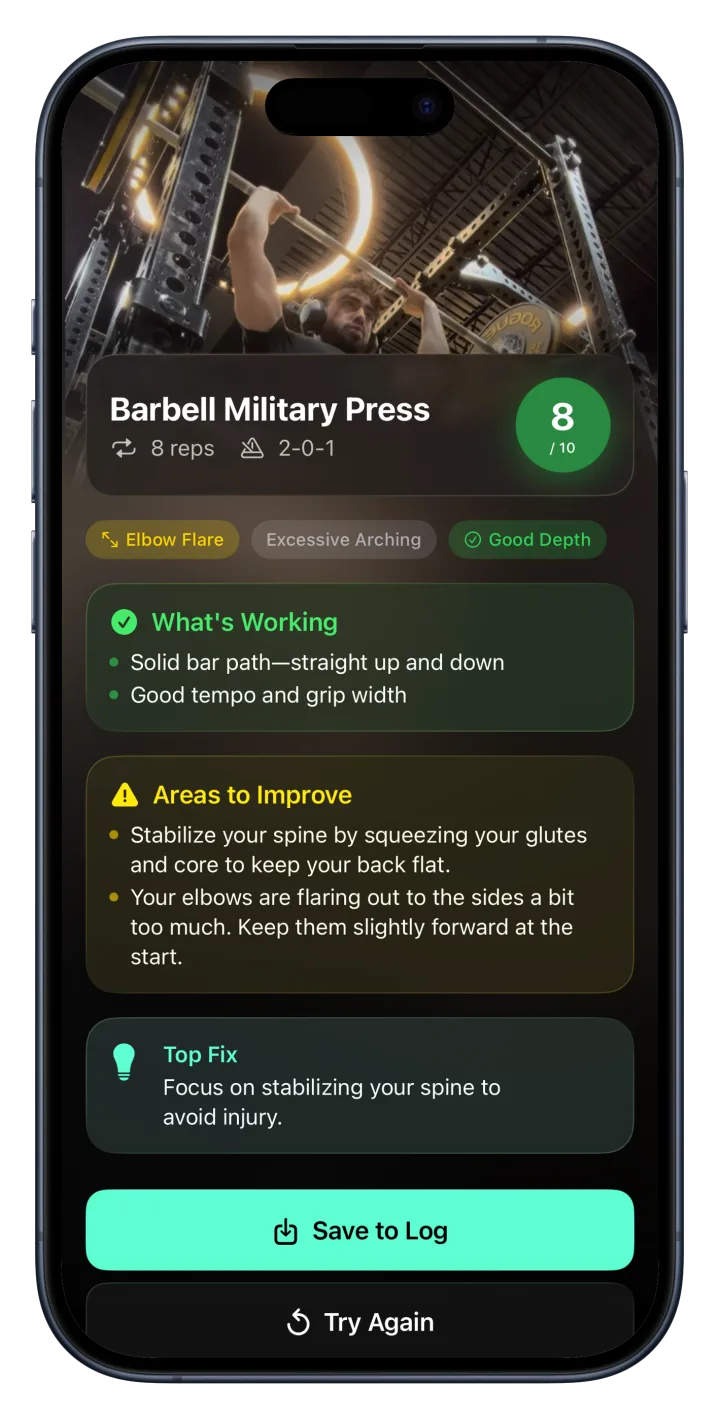
Most form feedback fails before analysis starts.
The common mistake is asking, "How was my form?" That question is too broad. A better form check asks, "Did this squat hit depth without losing brace?" or "Did the bar path drift when the set got hard?"
Video helps because it turns a disappearing moment into something reviewable. Research on smartphone and app-based measures in resistance training is strongest for bar velocity and movement measurement, not for magic technique judgment. Systematic reviews suggest mobile tools can be useful, but accuracy depends on setup, load, movement, and method.
That is the important lesson for lifters: the camera is not valuable because it is fancy. It is valuable because it makes the same rep comparable over time.
The mirror is biased toward the moment.
During a hard set, attention is split between bracing, balance, pain, fatigue, and getting the rep done. The mirror adds another problem: it asks you to judge technique while changing head position and reacting in real time.
Video removes that burden. You lift first. Then you look. That separation matters. Technique problems often appear at the same point in the set: the first rep when you rush setup, the last rep when fatigue breaks position, or the transition where tempo changes.
The best form check does not ask for a perfect lift. It asks for one visible pattern and one next correction.
A useful lifting video has four rules.
- Keep the angle repeatable: side or 45-degree views are usually more useful than a random front selfie angle.
- Capture the whole lift: bar, joints, and feet should stay in frame when possible.
- Log the set context: load, reps, RIR, and whether the video is a warm-up, working set, or near-max attempt.
- Ask for one priority: depth, bar path, tempo, brace, lockout, or another specific pattern.
That setup turns video from content into evidence. The same lift, same angle, and same question make improvement easier to see.
Scores are only useful when they explain themselves.
A 7/10 score can be motivating, but by itself it is thin. The useful part is the breakdown: what worked, what changed under fatigue, and what to try next.
That is the practical form-check premise. The score gives orientation. The strengths and fixes make it actionable. The next cue keeps the lifter from drowning in critique.
This matters because technique feedback can easily become vague: "keep tight," "better depth," "control it." A useful feedback system translates that into something the lifter can test on the next set.
The viral version is simple: before, after, cue.
If you want form check content that is actually worth sharing, do not post a random max and ask strangers to argue. Post a pattern.
- Before: the rep where the issue appears.
- After: the rep after one cue or setup change.
- Cue: the single thing that made the second rep better.
That format is useful to the lifter, understandable to the viewer, and aligned with what a coaching tool should do: move from observation to action.
Sources
- Silva AF, et al. Validity and reliability of mobile applications for assessing barbell velocity in resistance training: a systematic review. PubMed
- Weakley J, et al. Validity and reliability of velocity measurements in resistance training. PubMed
- American College of Sports Medicine. Resistance Training Prescription for Muscle Function, Hypertrophy, and Physical Performance in Healthy Adults: An Overview of Reviews. PubMed
- Helms ER, et al. RPE scale based on repetitions in reserve for resistance training. PubMed