
Readiness / Evidence Guide
Readiness Is a Conversation, Not a Score
A recovery number can be useful. It becomes risky when it replaces the actual evidence from your sleep, soreness, mood, warm-ups, and recent training load.
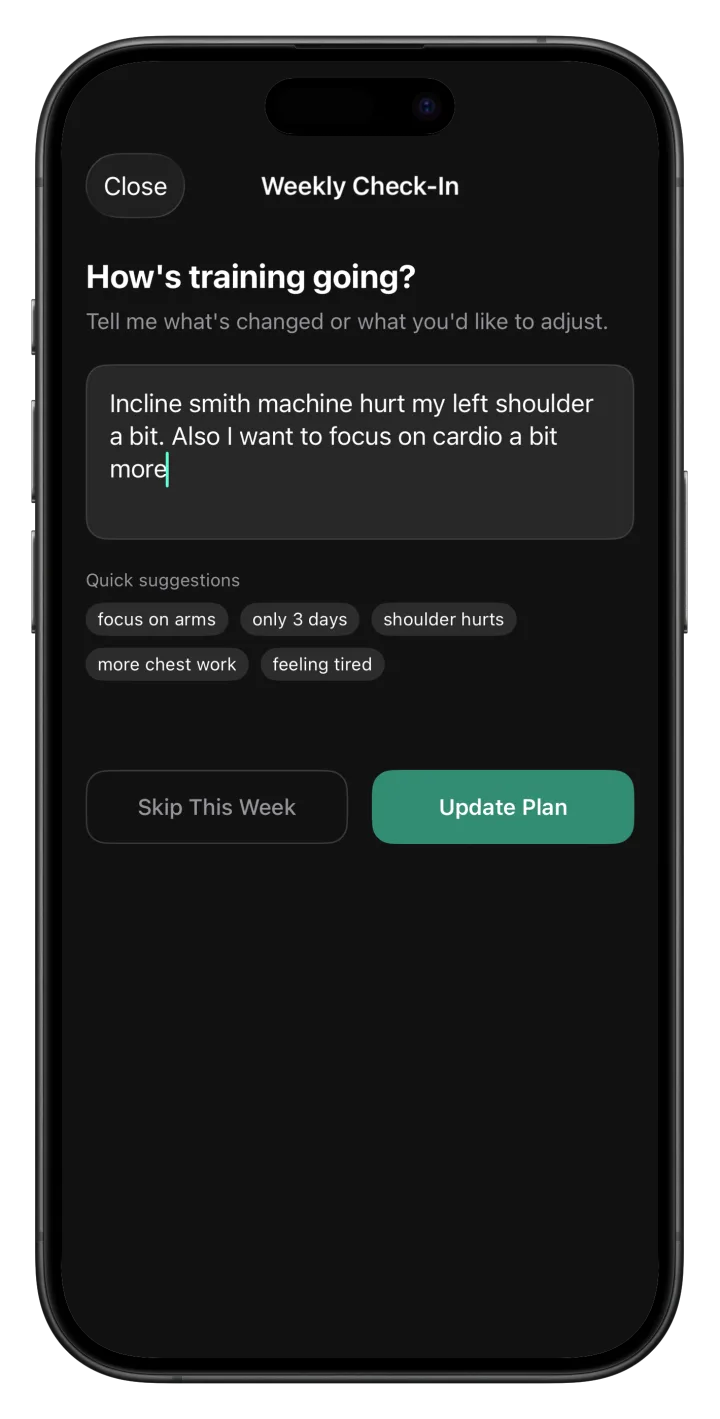
A readiness score is not a coach.
Readiness tools can be helpful because training does not happen in a vacuum. Sleep, stress, soreness, prior volume, travel, food, and life all change what a set costs.
The mistake is treating readiness like a traffic light. Green means push. Red means stay home. Real training is usually more nuanced. A low-readiness day may need fewer sets, easier load targets, longer warm-ups, or a technique focus. It does not always need a full cancellation.
The useful question is not "What is my score?" The useful question is "What should this signal change about today's plan?"
Subjective signals are not soft.
One of the most practical findings in athlete-monitoring research is that simple self-report measures can be responsive to training load. Saw, Main, and Gastin reviewed athlete monitoring studies and found that subjective self-reported measures were often more responsive than commonly used objective measures.
That does not make every check-in perfect. A 2020 systematic review of single-item wellbeing measures found inconsistent designs and relationships with training load that ranged from none to very large, often with mostly trivial to moderate associations in larger samples. Translation: the signal is useful, but it needs repeated context and humility.
Subjective does not mean fake. It means the measurement depends on honest repetition.
Wearables help most when they show trends.
Heart-rate variability and related autonomic measures can provide useful information about training adaptation, especially when tracked consistently. A systematic review and meta-analysis by Bellenger and colleagues found autonomic heart-rate regulation changes alongside positive and negative training adaptations in endurance-trained athletes.
Still, HRV does not explain everything. Halson's review on training load monitoring emphasizes that fatigue is multi-factorial and that monitoring systems should combine external load, internal response, and the athlete's context. A wearable value should start the conversation, not end it.
That is especially true for lifters. A bad readiness value does not tell you whether squat depth, bar speed, shoulder irritation, poor sleep, or accumulated volume is the main issue. The log has to connect the signal to the set.
Sleep matters, but slogans are too clean.
The 2021 British Journal of Sports Medicine sleep consensus for athletes notes that elite athletes are susceptible to short sleep and poor sleep quality, and that a night or more without sleep can reduce athletic performance. The authors are also careful about uncertainty: partial sleep restriction across one to three nights is a more real-world scenario, and the evidence is not always clean.
That is exactly why sleep should be logged as context. "Slept 5 hours" should not automatically delete the workout. It should make the plan more cautious about interpreting misses, grinders, pain signals, and unusually low motivation.
The best readiness check is boring.
Most lifters need a short repeatable check, not a complicated dashboard. Before the session, ask:
- Sleep: normal, low, or terrible?
- Soreness: local muscle soreness or whole-body fatigue?
- Stress and mood: baseline, distracted, or unusually flat?
- Warm-up performance: normal speed, slow, or technically off?
- Recent load: normal week, sudden spike, or missed sessions?
Then make the smallest useful adjustment. Reduce one top set. Cap RIR at two. Keep the same load but drop accessories. Move from PR attempt to clean technique work. The point is not to obey a score. The point is to keep training decisions connected to reality.
Readiness belongs beside the workout, not above it.
When readiness is separate from the log, it turns into mood trivia. When it sits beside sets, reps, load, rest, and effort, it becomes explanation.
If performance drops and readiness was normal, the program may need attention. If performance drops after poor sleep, high soreness, and a sudden volume spike, the same miss means something else. A good log makes that difference visible without pretending the body is a calculator.
Sources
- Halson SL. Monitoring training load to understand fatigue in athletes. PubMed
- Saw AE, Main LC, Gastin PB. Monitoring the athlete training response: subjective self-reported measures trump commonly used objective measures. PubMed
- Duignan C, et al. Single-item self-report measures of team-sport athlete wellbeing and their relationship with training load. PubMed
- Bellenger CR, et al. Monitoring athletic training status through autonomic heart rate regulation: a systematic review and meta-analysis. PubMed
- Walsh NP, et al. Sleep and the athlete: narrative review and 2021 expert consensus recommendations. British Journal of Sports Medicine