
Effort / Evidence Guide
Reps in Reserve Is the Honesty Layer
RIR turns "that felt heavy" into a usable coaching signal. The catch: it works best when you log it honestly and interpret it with context.
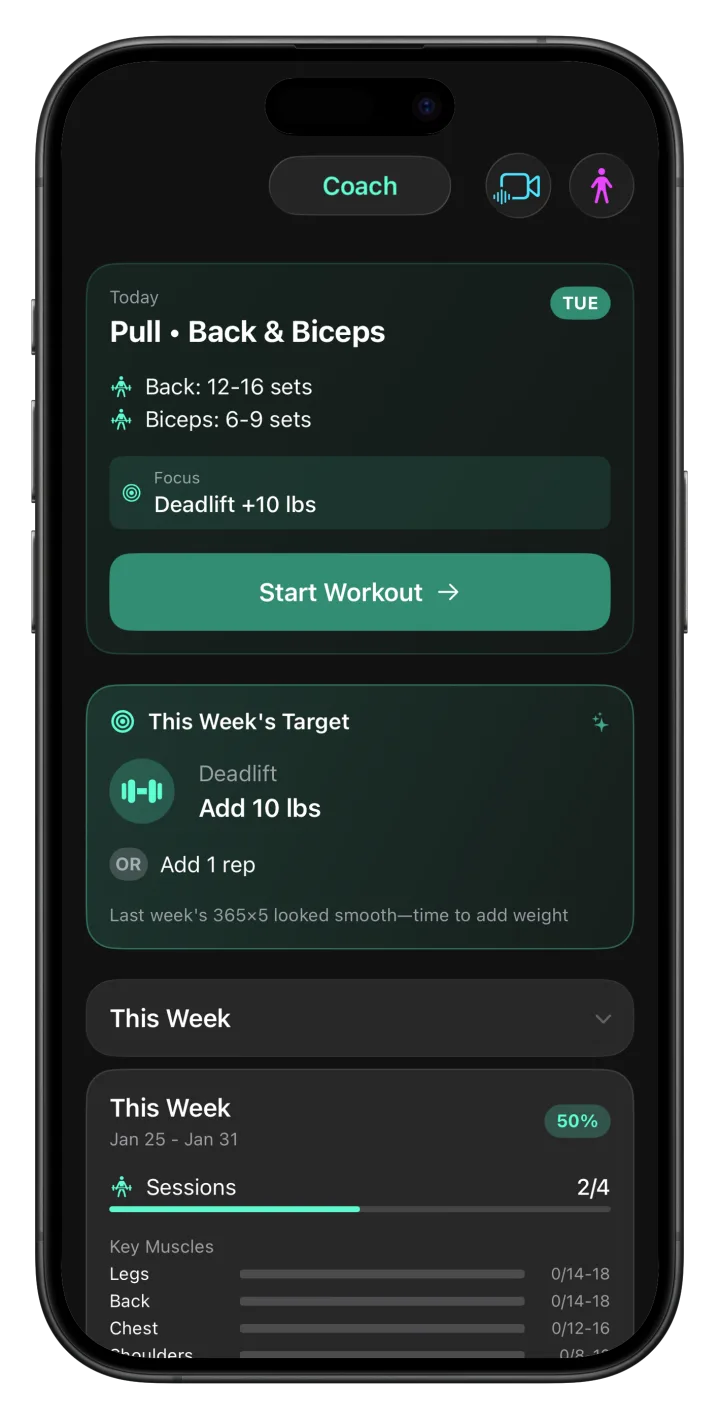
Effort is the missing variable in most logs.
Two lifters can both log "225 x 8." One had five reps left. The other barely survived rep eight. On paper, those sets are identical. In training reality, they are different inputs.
Reps in reserve, or RIR, asks a simple question: how many good reps were left when the set ended? It is closely tied to RPE systems used in strength training. Helms and colleagues helped popularize a resistance-training RPE scale anchored to RIR, giving lifters a language for autoregulation without needing lab equipment.
The value is not that every RIR estimate is perfect. The value is that effort becomes visible enough to guide progression.
RIR is useful because failure is expensive.
Training to failure has a role, but it is not automatically superior. Meta-analytic work comparing failure and non-failure training suggests that failure is not required for gains in strength or hypertrophy. More recent reviews on proximity to failure are more nuanced: getting reasonably close to failure can matter for hypertrophy, especially with lighter loads, but living at failure can add fatigue that does not always buy more adaptation.
For a coach, that distinction matters. If every set is logged as "hard," the program cannot tell the difference between a productive hard set, a maximal grinder, and a set that should have stopped two reps earlier.
RIR is not a badge of toughness. It is a way to price the fatigue cost of a set.
The honest RIR ranges.
Most lifters do not need a perfect 10-point scale. They need honest buckets:
- 4+ RIR: easy work, warm-up territory, or intentionally low stress practice.
- 2-3 RIR: productive working sets for many strength and hypertrophy blocks.
- 1 RIR: very hard, usually still clean enough to repeat when recovery is good.
- 0 RIR: true failure or no clean rep left. Useful sparingly; costly if it becomes the default.
Research on subjective proximity to failure also warns that accuracy is imperfect. Lifters are often better at judging near the end of a set than early in a set, and estimates improve with practice. That is fine. A rough but consistent effort note is still more useful than no effort note.
How a useful log should use RIR.
A single RIR value should not make the whole decision. It should sit next to load, reps, movement, recent trend, and recovery context.
If you hit 3 sets of 8 at 2 RIR, the next move might be to add load. If you hit the same numbers at 0 RIR with worse form, the next move might be to repeat, reduce volume, or fix technique. If the same set felt like 4 RIR after a week of better sleep, the program should notice that too.
This is why effort belongs in the log, not just in your memory. Memory turns hard sets into stories. A log turns them into decisions.
The anti-slop rule: only log effort when it changes the next call.
You do not need to score every warm-up. You do not need to invent decimal RPE. You do need effort notes on the sets that drive progression: top sets, final working sets, back-off sets that felt unusual, and any set where technique changed.
That keeps effort tracking from becoming another chore. The best RIR log is not obsessive. It is specific enough that tomorrow's plan is harder to lie to.
Sources
- Helms ER, et al. RPE scale based on repetitions in reserve for resistance training. PubMed
- Grgic J, et al. Effects of resistance training performed to repetition failure or non-failure on muscular strength and hypertrophy. PubMed
- Carvalho L, et al. Muscle hypertrophy and training proximity-to-failure: a systematic review and meta-analysis. PubMed
- American College of Sports Medicine. Resistance Training Prescription for Muscle Function, Hypertrophy, and Physical Performance in Healthy Adults: An Overview of Reviews. PubMed